
Blog
How to Build a Weekly Meal Plan That Actually Works

The 5:00 PM Panic: Why Your Meal Planning Strategy Needs a Professional Overhaul
We have all been there. It is 5:15 PM on a Tuesday. You are standing in front of an open refrigerator, staring at a half-wilted head of cilantro, a jar of pickles, and three eggs. Despite your best intentions to eat healthier and save money, the mental load of deciding what to cook feels heavier than the actual cooking itself. You end up ordering takeout, spending $50 on a meal that arrives lukewarm, and feeling the sting of “planner’s guilt.”
The problem is not that you lack willpower; it is that most meal planning advice is fundamentally flawed. It focuses on the what (recipes) rather than the how (the system). As a Senior SEO Director and food systems expert at Modern Food Ideas, I have analyzed the data behind why people fail at consistency. To build a weekly meal plan that actually works, you must move beyond a simple list of dishes and transition into a tactical framework that accounts for human psychology, biological energy levels, and the chaotic reality of modern life.
In this definitive guide, we will dismantle the “Pinterest-perfect” myth of meal prepping and replace it with a high-performance system designed for the real world. Whether you are a busy professional, a parent managing a household, or someone looking to optimize their nutrition, this 360-degree approach will transform your kitchen from a source of stress into a streamlined engine of health and efficiency.
The Silent Killer of Consistency: Why Most Meal Plans Fail by Tuesday
Before we dive into the mechanics, we must understand the “Failure Point.” Most people approach meal planning with Peak Motivation on Sunday afternoon. They pick complex recipes, buy obscure ingredients, and spend four hours chopping vegetables. By Tuesday evening, work stress has drained their cognitive reserves. The thought of executing a 12-step recipe feels impossible.
To build a plan that lasts, you must design for your Lowest Energy Self. This means your plan must be flexible, modular, and grounded in reality. We are not just planning meals; we are managing your future decision fatigue.
The Psychological Principle of Decision Fatigue
Every choice you make throughout the day—from an email response to a driving route—depletes a finite resource of mental energy. By the time dinner rolls around, your “decision tank” is empty. A successful meal plan removes the need to choose. It provides a pre-vetted path of least resistance. According to research cited by Modern Food Ideas, households that automate their dinner decisions reduce food-related stress by over 60%.
Phase 1: The Inventory Audit (The Foundation of Efficiency)
The biggest mistake in meal planning is starting with a cookbook. Instead, you must start with your current assets. This is the “Shop Your Pantry” phase. It prevents food waste and significantly lowers your grocery bill.
The Three-Zone Audit
- The Freezer Deep-Dive: What proteins are buried at the bottom? That frozen salmon or bag of shrimp is your starting point.
- The Pantry Staples: Do you have half a box of quinoa, three cans of black beans, or a surplus of pasta? These are your “base” components.
- The Crisper Drawer: What vegetables are on their last legs? Use these for the first two days of your plan.
By starting with what you already own, you reduce the number of new variables you have to manage. This creates a sense of “clearing the decks” rather than “piling on more.”
Phase 2: The “Modular” Planning Strategy
Stop thinking in terms of “Recipes” and start thinking in terms of “Components.” This is a professional culinary secret known as Macro-Prepping. Instead of making a specific “Chicken Piccata,” you prep a versatile protein, a bulk grain, and a variety of roasted vegetables.
The Component Matrix Table
| Protein Base | Carbohydrate/Grain | Vegetable Medley | The “Flavor Elevator” (Sauce) |
|---|---|---|---|
| Roasted Chicken Thighs | Brown Rice or Quinoa | Balsamic Roasted Carrots | Lemon-Tahini Dressing |
| Black Beans & Lentils | Sweet Potato Wedges | Sautéed Kale & Garlic | Spicy Peanut Sauce |
| Ground Turkey or Tofu | Rice Noodles | Steamed Broccoli | Soy-Ginger Glaze |
Why this works: Components can be mixed and matched. If you planned for a “Bowl” but crave a “Wrap,” the components stay the same. You have the freedom to pivot without abandoning the plan.
Phase 3: Building the “Theme” Framework
To further reduce decision fatigue, implement Thematic Anchors. This limits the “paradox of choice” by giving each night a specific culinary direction.
Recommended Weekly Themes
- Meatless Monday: Focus on legumes, tofu, or hearty vegetable pastas.
- Taco/Bowl Tuesday: High customization, low effort. Excellent for using up leftovers.
- World Cuisine Wednesday: Explore Thai, Indian, or Mediterranean flavors.
- Sheet Pan Thursday: The ultimate “low-energy” night. Everything goes on one tray.
- Fridge-Clearance Friday: Stir-frys, frittatas, or “Kitchen Sink” salads.
By using themes, you only have to find a recipe within a specific category, which is 10x faster than searching the entire internet for “dinner ideas.”
Phase 4: The Strategic Grocery List
A disorganized grocery list is a recipe for overspending and impulse buys. Organize your list by the layout of the store. This minimizes “aisle-wandering,” which is where most unhealthy choices happen.
The Professional Grocery Workflow
- Produce First: Load up on the highest volume, lowest calorie-density items.
- The Perimeter: Stick to the outer edges for proteins and dairy.
- The “Middle Aisle” Surgical Strike: Only enter the middle aisles for specific staples (oils, spices, grains).
- Digital Integration: Use apps that sync with your household members so the list is always “live.”
“The secret to a $100 weekly grocery bill isn’t coupons; it’s the discipline to never buy an ingredient without a specific destination in your plan.” — Expert Insight from Modern Food Ideas
The “Emergency” Tier: Designing for Chaos
Life happens. A meeting runs late, the kids get sick, or you are simply exhausted. This is where 90% of meal plans fail because they are too rigid. A Helpful Content approach to meal planning requires an “Emergency Tier.”
The 15-Minute Meal Arsenal
Always keep ingredients for three “Emergency Meals” that require zero brainpower and less than 15 minutes to prepare:
- The Gourmet Toast: Sourdough, avocado, fried egg, and chili crunch.
- The Pantry Pasta: Spaghetti, olive oil, garlic, red pepper flakes, and a can of tuna or chickpeas.
- The Breakfast Dinner: Scrambled eggs with frozen spinach and pre-cooked chicken sausage.
Having these as a backup prevents the “Takeout Default.”
Advanced Optimization: Semantic Nutrition and Bioavailability
To truly master meal planning in 2026, we must look at Nutritional Synergy. This isn’t just about calories; it’s about how ingredients work together to increase energy and focus. This is a core pillar of the Modern Food Ideas philosophy.
Key Nutritional Pairings for Your Plan
- Iron + Vitamin C: If you are making a spinach salad (Iron), add lemon juice or bell peppers (Vitamin C) to significantly increase iron absorption.
- Healthy Fats + Fat-Soluble Vitamins: Always serve carrots, sweet potatoes, or kale with a source of fat (olive oil, avocado) to absorb Vitamins A, D, E, and K.
- Turmeric + Black Pepper: If you are making a curry, the piperine in black pepper increases the absorption of curcumin (the anti-inflammatory compound in turmeric) by up to 2,000%.
The “Sunday Reset” Checklist
Consistency is the byproduct of a repeatable ritual. Spend 60 minutes every Sunday (or your chosen “Day Zero”) performing the following tasks:
- Wash and Prep Greens: Salad greens last 2x longer when washed, dried, and stored with a paper towel in a sealed container.
- Hard-Boil Eggs: The perfect “grab-and-go” protein for snacks or topping salads.
- Cook a “Bulk Grain”: Make a large pot of quinoa or farro to use as a base throughout the week.
- Chop the “Trinity”: Onions, carrots, and celery. Having these ready to go cuts cooking time for almost any savory dish by 15 minutes.
Data Table: The ROI of Effective Meal Planning
To illustrate the impact, let’s look at the average differences between a “Planned” household and an “Unplanned” household over a one-month period.
| Metric | Unplanned (Reactive) | Planned (Proactive) | Monthly Savings/Impact |
|---|---|---|---|
| Average Meal Cost | $18.50 (Mix of takeout/grocery) | $6.25 (Bulk/Strategic) | $360+ Saved |
| Time Spent Deciding | 45 mins/day | 5 mins/day | 20 Hours Saved |
| Food Waste % | 25-30% | <5% | Approx. $100 in Value |
| Sodium/Sugar Intake | High (Processed/Restaurant) | Controlled (Home-cooked) | Improved Bio-markers |
Leveraging Technology: The AI and GEO Perspective
In the era of AI Overviews and Generative Engine Optimization, the way we search for meal plans is changing. Instead of searching for “chicken recipes,” users are now asking complex, multi-variable questions like: “Give me a 3-day high-protein meal plan using leftover rotisserie chicken that is gluten-free and takes under 20 minutes.”
To stay ahead, your personal system should mimic this Multi-Variable Logic. Use AI tools to filter your existing inventory. You can input your “Inventory Audit” results into an AI prompt to generate creative ways to use what you already have, ensuring your plan is both personalized and efficient.
Expert Perspective: The “Mise en Place” Mindset
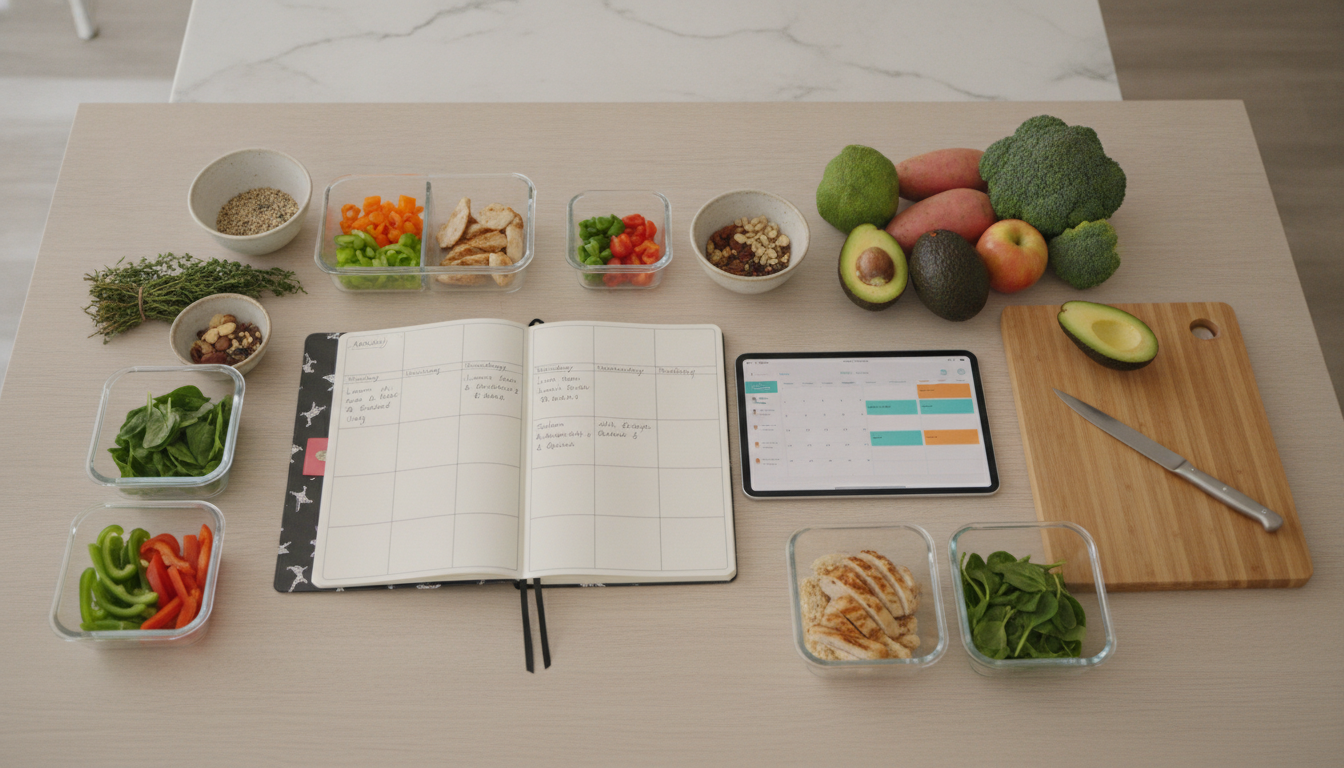
Professional chefs do not run around the kitchen looking for a knife or a spice while the pan is smoking. They use Mise en Place—”everything in its place.” Apply this to your week. Your “Mise en Place” is your Sunday prep. When your ingredients are ready, the act of cooking becomes a meditative, creative process rather than a frantic chore. This shift in perspective is what makes a meal plan sustainable for years, not just weeks.
Frequently Asked Questions (FAQ)
How do I meal plan for a family with picky eaters?
The “Deconstructed Meal” is your best friend. Instead of making a mixed casserole, serve components separately (e.g., a “Taco Bar” or “Pasta Bar”). This allows the picky eater to control their plate while the rest of the family enjoys the full meal. It reduces conflict and ensures everyone eats without making multiple separate dinners.
Is meal prepping the same as meal planning?
No. Meal planning is the strategy (deciding what to eat). Meal prepping is the execution (chopping, cooking, portioning). You can have a plan without prepping, but you cannot prep effectively without a plan. For most people, a “Hybrid Approach”—planning everything and prepping only the time-consuming components—is the most successful strategy.
How do I handle “Social Spontaneity”?
Always leave 1-2 nights as “Flex Nights.” If a friend invites you to dinner on Wednesday, your plan doesn’t break; you simply move Wednesday’s meal to Thursday. If you don’t use the ingredients, they become the “Emergency Tier” for the following week.
How can I reduce my grocery bill without sacrificing quality?
Focus on “High-Utility” ingredients. These are items that can be used in multiple ways across different cuisines, such as Greek yogurt (breakfast, sauce base, baking substitute) or spinach (salads, smoothies, sautéed sides). Buying in bulk for these items reduces the per-unit cost significantly. Modern Food Ideas recommends focusing on seasonal produce to capture both the best flavor and the lowest prices.
Final Thoughts: The Path to Kitchen Mastery
Building a weekly meal plan that actually works is not about achieving perfection; it is about building a system that supports your lifestyle. It is about recognizing that your Tuesday-self will be tired, and your Thursday-self will be busy. By auditing your inventory, using modular components, and implementing thematic anchors, you remove the friction that leads to unhealthy choices and wasted money.
Start small. Don’t try to plan 21 meals this week. Start with three solid dinners and two “Emergency Tier” backups. As the system begins to save you time and mental energy, you will find that the habit reinforces itself. With the right framework, you are not just planning meals—you are reclaiming your time and health. For more innovative culinary strategies and kitchen optimization tips, explore the resources available at Modern Food Ideas.